
Setting a Tone: Interlude–Possibly Probably Likely Certainly the Most Powerful Left-Hand Boogie-Woogie Ever
Lessons with Sammy Price, the King of Boogie-Woogie

In which we look at “Hot Club Boogie”. I’ll return to the story of Sammy Price’s appearance at the University of Massachusetts and Chapter Nine next week.
Here’s a 30-second sample of “Hot Club Boogie”. Paris, May 14, 1956.
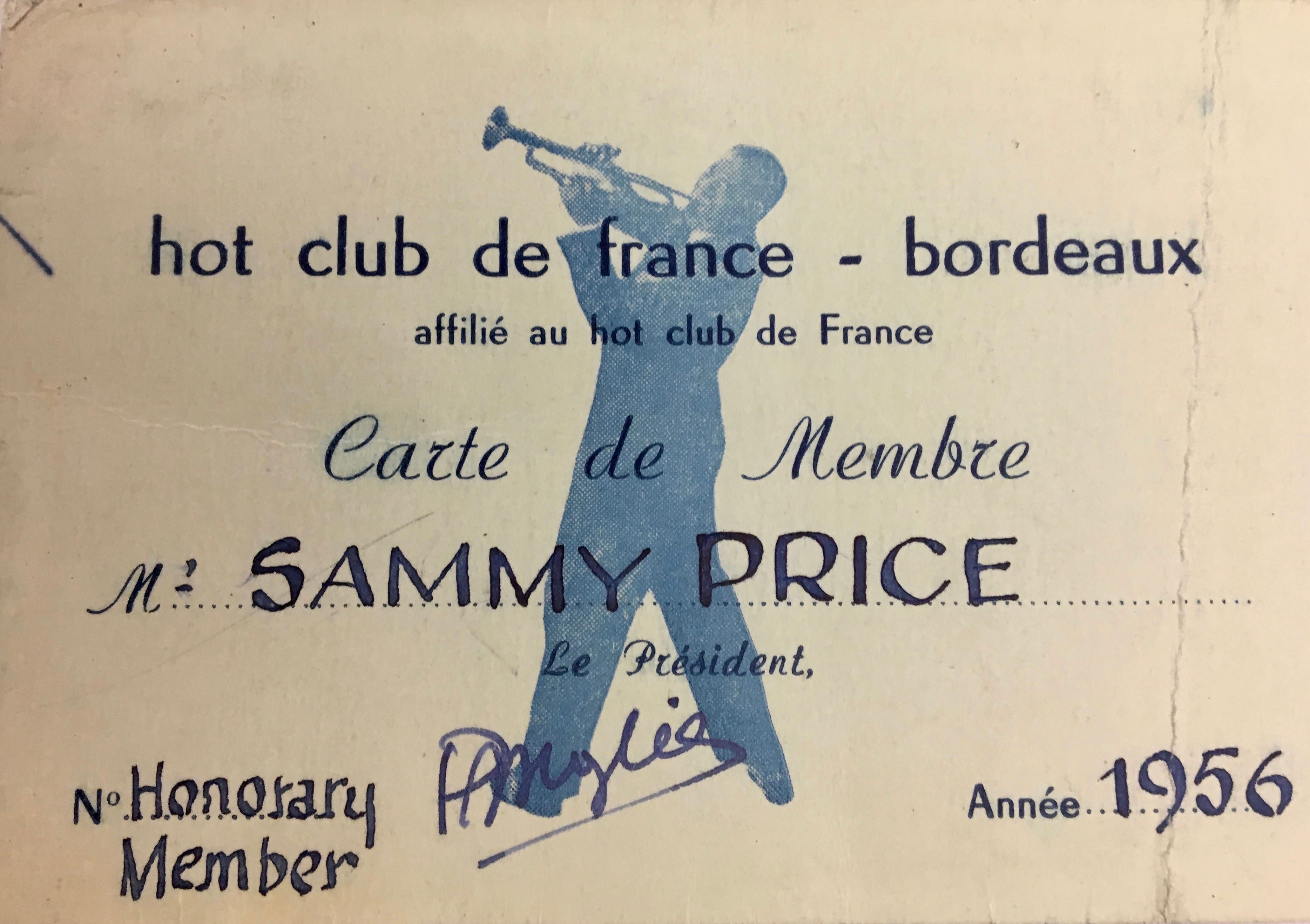
One time when we were discussing music, Sammy said that whenever he went to Paris, people on the streets, “Come up to me like I’m giving away candy.”
I didn’t doubt that. I knew he had made many trips to France, and I had heard the applause on Sammy’s 1955 album of live recordings, “Sammy Price in Concert,” made during his Music for the Youth, or “Les Jeunesses Musicale” tour.
Though I had not yet heard the group of other recordings Sammy made in France in the late 1940s and through the 1950s.
My listening experience was from afar, but there was a document in Sammy Price’s collection of papers housed at the Schomburg Center for Research in Black Culture that brought me much closer to a sense of Sammy’s experience and reception in France. A reception that had apparently continued to the day he spoke to me about it.
The document consisted of nine single-spaced typed pages written by a Swiss man and ardent jazz fan who had come to know Sammy, become his close friend, even visiting him at home on a trip to New York. The document is unsigned, and the man’s name does not appear. He depicts Sammy during a phone call greeting him as “Mr. Mochieu,” which may not have been his actual name, but I’ll use that name to refer to him here.
Mr. Mochieu’s account runs from 1938 to 1969. Mochieu is Swiss, and meets with other jazz fans for listening sessions.
“We are a bunch of six young guys who meet three or four times every week at each other’s home to do what we all like doing best: Enjoy the music on jazz-records. My friends are by far the hippest jazz-fans that I have known personally up to that time. Although each of us has his own personal preferences when it comes to individual musicians or records, we all fully agree on the BASIC principles which make real jazz the great music that it is and which separate it from the pseudo forms. We are a mixed bag: Two Dutchmen, an Italian, one Spanish fellow and two Swiss. Language communication is not always easy but it doesn’t matter much because it is the MUSIC that counts. We understand each other with few words.”
One night the group listens to four recordings by “Trixie Smith with Sammy Price’s Fly Cats,” from Sammy’s fourth session at the Decca Studios, on May 26, 1938. The tunes are “Freight Train Blues,” “Trixie’s Blues,” “Jack I’m mellow,” and “He may be your man (but he comes to see me sometimes).”
“The records are played over and over and we marvel at Sidney Bechet, Charlie Shavers, Teddy Bun, Richard Fullbright, and O’Neill Spencer, and last but not least Trixie’s singing. The only man on the date that I do not find particularly outstanding at the first few hearings is the piano-player of whom I haven’t heard before. My companions, however, seem to enjoy the piano playing (it is all background-work except for one short solo) as much as the rest. “Who is Sam Price?” asks Enrico Batlle. Karl Hiby, who somehow always knows what’s happening, explains: “Price is Decca’s new house-pianist in New York for “race records.” A Texas man. Plays great blues. Let’s spin the records again, concentrating on the piano this time.”
“Which we do and the more I listen, the clearer I’m getting the message and begin to realize the worth of the new piano-player. While on previous auditions I only heard him play a few single notes in the treble, I can now follow the pianist’s playing throughout. “I bet we will hear a lot of this man from now on. He’s too good to go unnoticed,” remarks Lux Hoch. “O Mama Mia,” is Reposi’s comment and since he is a guy who almost never opens his mouth and his “O Mama mias” are strictly reserved for the top jazzmen, we all think that Sam Price cannot be any ordinary piano plunker. Time has proven Carlo Reposi right.”
A sample of “Jack I’m mellow”. Sammy’s solo follows Sidney Bechet’s.
Mr. Mochieu’s story moves to the war years and 1943. All postal connections between the USA and Europe are cut off.
“However, one day I get a call to report to the local post office and when I do, I’m shown a box from the USA containing records, or I should say, dozens of small pieces which once–when still together–were gramophone records. My dear friend, Ernest “Bass” Hill, in New York, had dispatched twelve records to me. It took them fourteen months to get to Switzerland! (I never had the heart to tell him I never played 23 sides of the twelve records.) While eleven records are completely smashed, the 12th is in two pieces (only!) and one side can be saved by sacrificing the other. It’s a record by Sam Price and his Bluesicians “Fetch it to Me” and “Sweeping the Blues Away.” Remembering Sam Price’s wonderful Blues-playing with Trixie Smith, I put adhesive on “Fetch it to Me” and on the backing of Louis Armstrong’s “St. Louis Blues” on English Parlophone (I don’t remember what it was but I know it was a dud), press them together, put a few heavy books on them for the rest of the night and the next morning I have a perfectly playable copy of Pop’s first “St. Louis Blues” and Sam Price’s “Sweeping the Blues Away.”
'“This latter proves to be a real revelation: For the first time I hear Sam Price playing solo at length and he moves me even more than expected. For me, nobody can play slow blues better than this man. There’s so much beauty in his melody lines, in his full, rich chords and his inimitable way of phrasing. I have changed my mind about many things in life since 1943–musical and non-musical–but my admiration for Sam Price’s piano playing has not altered one bit.”
A sample of “Sweeping the Blues Away”
In 1946 the war is over and records from the USA become available again. One of the first to reach Mr. Mochieu in Switzerland is “I finally gotcha” by Sammy Price on Mezz Mezzrow’s “King Jazz” label.
“It is on this record that I hear Sam Price for the first time without any accompaniment and, recorded under ideal circumstances, I discover that his left hand is one of the most perfect heard from any pianist. “I finally gotcha” becomes (fast) one of my favorite piano-solos. I never tire to play it over and over again. It is one of the few records I decide to buy three copies of and I do.”
A sample of “I finally gotcha”.
The scene of the story moves to the first Nice Jazz Festival in 1948. The festival was founded by Hugues Pannasie. Pannasie is also the co-founder of the Hot Club Society of France. The Hot Club began as a listening club formed by five students, and developed into a formal organization that promoted concerts, published a magazine called Le Jazz Hot, formed a music label called Swing, and established regional Hot Clubs.
Mr. Mochieu is at the scene where Hugues Pannasie and others are awaiting the arrival of the bands of Louis Armstrong and Mezz Mezzrow. Their flight from New York has been diverted to Paris due to weather conditions and the musicians will travel by train. They will arrive not on Saturday as planned but on Sunday, the day of the opening of the festival.
The organizers are waiting for a call from the airport in Paris to learn if everyone arrived alright.
“After a while the phone rings and Mr. Castel starts shouting like mad because the communication is just awful. Finally, he puts the receiver on the table and, all out of breath, he croaks: “Everybody is in Paris except Le Lion.” Of course, Hugues wants to know the name of the last-minute substitute and Castel resumes his call: “Hello, hello, I beg you, don’t cut me off, I don’t understand anything, nothing, nothing!” After some minutes of shouting, Castel explains to his avidly listening audience: ‘Pierre Artis says Pahmie Draite has come instead. Is he any good?” I have a stroke of genius and solemnly declare: “I think it is Sammy Price.” Some more hollering and and then Castel–near tears and perspiring all over–hangs up and sobs: “Yes, it’s somebody by the name of Sahmy Braise.” Hugues puts on his most benign smile, “I saw him the first time. Marvelous Mezz! Sammy plays a different genre but will do as well as the Lion!”
The next morning Mr. Mochieu and his wife meet Sammy Price. They come upon him in a battle with a hotel clerk and Mezzrow’s road manager.
“While his fist beats a thundering eight to the bar rhythm on the reception desk, Samuel Price bellows: ‘I won’t share my room with another musician! I’m a sensitive artist! I must have peace of mind and a single room! Louis Armstrong’s men got single rooms too!’ Since the fulfillment of this new order cannot be promised right away, Sam Price finally runs out of the revolving hotel door, furious, disgusted, cursing and wildly gesticulating. I sprint after him, finally reach him, grab his arm and introduce myself. To my surprise it is not difficult to pacify him and lead him back to his single room with a view of the sea. I see him smile and then he explains: “People who raise hell CONVINCINGLY, ALWAYS get what they want!” We begin to find out what makes Mr. Price tick.
They go to Sammy’s hotel room, and Sammy opens a case with fifty ties, tells them to pick one for Mr. Mochieu and claims that it will look just as new twenty years from this day. Mochieu says that in 1969, the tie indeed looks as it did in 1948. (“I cannot say the same of my own appearance,” he remarks.)
“A few hours later we hear Sam with Mezz’s band which–while Louis is, of course, the greatest INDIVIDUAL performer–impresses us as the most exciting GROUP of the Festival. Mezz plays a lot of Blues in different tempos, of different moods and in different keys and many of them start off with several choruses by Sam Price, accompanied by Baby Dodds and Pops Foster. And the audience just LOVES them.
“However, all the posters and folders advertising the Festival are, of course, still showing Willie the Lion Smith’s name and, except for a few insiders, Sammy moves around Nice strictly incognito. Despite Mezz’s nightly explanation that his pianist’s name is Sammy Price (“the greatest blues piano player in the world”), the majority of the public and most of the journalists bravely stick to the printed program and are convinced they are enjoying “Le Lion”. One newspaper goes so far at to write: ‘Now I understand why Willie Smith is called The Lion. Indeed, he’s really roaring like a lion when he gets excited by the music.” Of course it is a well-known fact that Sam is an exceptionally calm and unexuberant type of performer when he is playing the piano.
“Sam is enjoying this unforgettable, marvelous week as much as the other musicians and their admirers (even today you can ask anybody who was there and hear them tell you it was a UNIQUE thrill). However, this quasi-anonymity does not please Sam at length. He does not like to be addressed, “Can you sign your autograph, Monsieur Smith?” and more than once we hear him grumble: “This is Mochieu Price! Mochieu Smith is in New York!” Then, turning to us, he says, “Think of all the publicity The Lion is getting from me. He’ll come over someday and he’s already an established popular attraction!”
Mr. Mochieu’s account moves ahead a few years to 1955, and Sammy’s return for the Music for the Youth tour.
“In December, 1955, Sam brings a fine band to France and plays a tour that lasts several months for Les Jeunesses Musicales Francaises. His two records for Vogue (one with Sidney Bechet and published under Bechet’s name, the other “A Real Jam Session with Sammy Price’s Blusicians”) are real jazz performances of generally excellent quality (although Emmet Berry–with Sam the most most interesting soloist in the group–had occasional lip trouble).
“However, for me, the high spots are the tracks on which the leader’s piano is most prominently featured. Sam’s wealth of ideas and means of expression on the Blues must be heard to be believed! If there are people who think they are ‘hearing the same thing all over again,’ I can only say that they completely miss the point and better get themselves a new nervous-system and a pair of new ears.”
Mr. Mochieu ends his account of this period by mentioning three “special favorites” among the recordings it produced. One was “Sammy Plays the Blues for Mezz,” (“with its four grand choruses, even for Sam this is exceptional”). Another was “U.S.I.S. Blues”.
The third was “Hot Club Boogie.” It is also my special favorite, and the boogie-woogie recording by Sammy Price that I have listened to more than any other. I could adapt Mochieu’s comment and say, “With its twenty-three choruses, it is truly exceptional, even for Sammy.”
It certainly is one of the greatest boogie-woogie tunes ever recorded. Though like so much else about Sammy Price, it has not seen the attention other more famous pieces like “Shout for Joy,” “Boogie-Woogie Stomp,” “Roll ‘Em Pete,” or “Honky-Tonk Train Blues” have received.
I think I can claim that as far as left-hand work on a boogie-woogie, nothing matches what Sammy Price does on “Hot Club Boogie” in intensity and variation.
“Hot Club Boogie” was recorded during a May 14, 1956 session in Paris. Sammy performed with a trio, with Pierre Michelot playing double bass, and Andre Reilles on drums.
One could say that because “Hot Club Boogie” was performed with a trio that it is a jazz tune with boogie-woogie themes, played in a jazz format. Especially since there is a bass solo. But it is so solidly and stridently boogie-woogie at its absolute rollicking best that the claim wouldn’t hold. It’s simply boogie-woogie with a rhythm section. Actually, it is boogie-woogie, blues, and jazz.
In the next six paragraphs I’ll give some technical analysis of “Hot Club Boogie.” If you’re not into that sort of thing, move ahead to the final two paragraphs, and the recording.
Simply, “Hot Club Boogie” is in the key of F and consists of twenty-three choruses. Each chorus is in the twelve-bar blues structure.
Of those twenty-three choruses, eleven begin with four-bar “breaks,” or introductory sequences, that provide a kind of relief, and variation. Of those eleven breaks, none are the same, each follows a different pattern and a slightly different rhythm.
The tune consists of two primary parts. After fifteen choruses, Sammy seems to bring “Hot Club Boogie” to a close. It would have been an exceptional boogie with its four-minute length. But after a moment’s rest Sammy calls out “Encore!” He takes off on a fast shuffle in his left hand and the two other musicians join in at the fifth bar, in perfect synch.
The first section comes to a powerful climax, but the second section with its eight choruses builds to an even greater climax. It does this largely with the use of a very difficult to play walking bass figure. I call it an upside-down or reverse-walking bass, in which the first note, the lower note in the octave, is played as an eighth note starting on the upside of the 4th beat of the previous bar. Sammy transitions in and out of that fluidly, and makes it the dominant bass figure in the climactic sections.
Despite all the transitions to varying bass lines, while improvising riff figures in the right hand, and making the eleven breaks, each different in its own way, almost every chorus comes down to 15 seconds in length. That’s four choruses per minute, at about 170 beats per minute.
Of the bass figures, he uses a fast shuffle that moves from an open fifth to an open sixth, hitting each twice in the bar. He plays the most commonly used 5th and 6th with a flatted third moving to a third. He makes many single note runs. He plays a straight walking bass, as well as the reverse walking bass. This in addition to several single-note offbeat accents and pops. And the descending turnaround figures, with their varying bass lines, used during the breaks.
Imagine you’re in an audience in France, seventy years ago, and you’re hearing your first jazz, and this number plays. You’re feeling happy to be alive. If you saw him somewhere, on the boulevard, you’d run to him like he was giving away candy.
Grateful thanks to Mr. Mochieu.
While Whynott"s masterful analysis of Sammy Price's "Hot Club Boogie" is way over my head (as is quantum entanglement), I enjoy that the music somehow works at a distance within the physical and aesthetic realms we inhabit. Loved this chapter. Thank you.