
Setting a Tone: Chapter Twelve–A Man About Harlem, NYC
Lessons with Sammy Price, the King of Boogie-Woogie

Sammy Price as a social activist and celebrity pianist in Harlem, as told through his community newspaper.
If I had been born in say, 1908, and lived in Harlem, and read the local newspaper, Amsterdam News, through the decades from the 1940s into the 1980s, I would have known a great deal about the life and varied activities of Sammy Price.
I would have seen the January 21,1941 story, (previously touched upon in Chapter Six), that read:

“For your edification, Sam Price is a piano player, and a doggone good ‘un whose rhythms come from Deep Elm street of his native Dallas; the jive joints of Chicago’s South Side; the swing parlors in St. Louis and Kansas City and in other perfectly solid parts of this good old U.S.A….
And with the final lines; “Now, Price’s name is magic in downtown swing circles. he’s invited everywhere. He has plenty of work; money is coming in and he’s in demand all over.”
I would have read that Sam Price was producing music on Broadway for a boogie-themed show starring the singer and actress Tallullah Bankhead (1942).
Would have seen that Sam Price had opened a talent agency on Broadway (1945);
Would also have seen that in the “Back Door Stuff” column (1948), under the “Harlem, Broadway, Hollywood” heading, that Billie Holiday had proudly acquired a new Cadillac, that Art Tatum was playing at the Famous Door, and that Sam Price, “one of the world’s greatest blues and boogie-woogie pianists”, was playing in the “luxurious Zebra Room in the Lenox Lounge.”
I would have seen the May 1, 1948 Amsterdam News story that read:

“Sam Price opened his pet project, The Jazz Room in the basement at Tom Delaney’s place, 137th St. and Seventh Ave., to a packed house Tuesday night, and the consensus was that the idea had clicked and would be permanent. An array of brilliant Dixieland jazz players kept the music going all night long and a coterie of clever entertainers filled in between sets.”
Followed by a curious paragraph: “It was Ma Price, Sam’s mother, however, who stole the show. An old-time blues singer and recording artist, Mrs. Price was prevailed to do a number. Her son left the room because of personal scruples in which makes it a rule never to listen to his mother sing the blues in a nightclub. She was in good voice and really showed the young blues chirpers in the audience what it is all about.”
I would have seen the 1948 item announcing that Sam Price had returned from a tour in Europe with the Mezz Mezzrow group, and would return soon–that he “was said to have set Paris afire with his boogie piano plunking.”
I would have read the 1956 story titled “Unofficial Ambassadors Back to US,” reporting that the Sammy Price All-Star jazz band was back from their five month tour of Europe and North Africa, performing under the sponsorship of the French government program “Les Jeunesses Musicales”. That “critics, fans, and officials continually referred to them as ‘ambassadors of good will.’”
In April, 1960, I would have seen in Les Matthews regular column, “Mr. 1-2-5 Street”, a roundup of the goings-on in Harlem, that “Bayard Rustin, who conducted the mike at the Student Sit-down rally in front of the Hotel Theresa Saturday, is one of the best MC’s heard in this area in several years. Sam Price is also loud and clear.”
In April, 1961 in “Mr. 1-2-5 Street I would have seen that “Henry Red Allen who purchased a red Caddy for his wife will move into the Embers with Sam Price and Jimmy Potter.”
I would have seen the March 18, 1961 story that began with the paragraph: “Harlem will finally have its own Jazz Festival.”
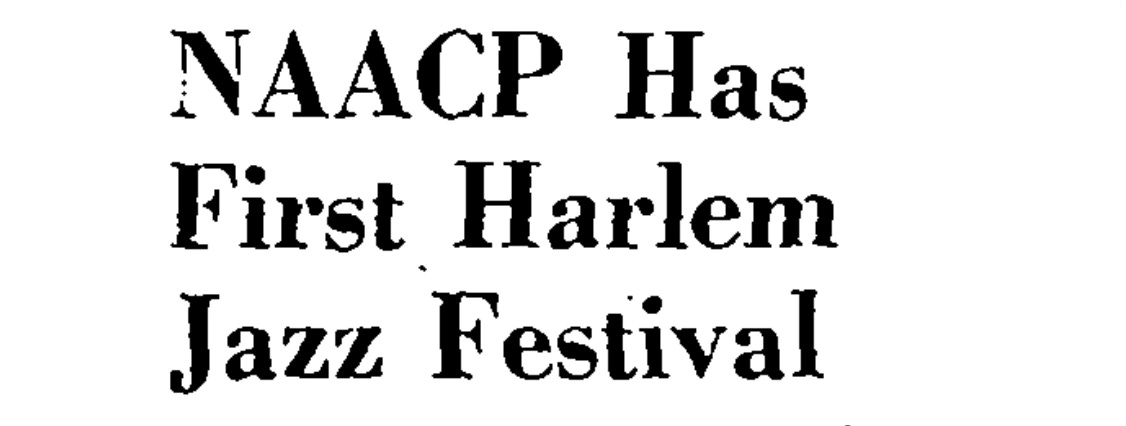
The story reported that the New York branch of the NAACP would hold a three-night festival to raise funds and increase the membership of the NAACP Branch following their move to new offices on 125th Street.
“Opening night will feature Dinah Washington, Lionel Hampton, and Gerry Mulligan.
“The second night will feature Duke Ellington. Plans call for various organizations to salute the Duke with a 100-lb birthday cake. He will play, for the first time, “The Harlem Jazz Festival Suite.”
“Co-starring on the program will be Miss Sarah Vaughn and Dave Brubeck.
“Tentative plans are for Louis Armstrong to be named King of the Festival.
“Sammy Price, popular pianist and impresario, is producing the show.”
As the months passed I would have seen additional news items in the various columns:
I would have seen in “Theatricals” (1962) that Sam Price was running for the New York State Assembly and gaining friends, and that later he dropped out of the race.
In “Theatricals” (1962) that Sam Price was opening a sausage business called “Down Home Products,” [while also playing at Eddie Condon’s club], and that a year later due to labor strikes and cold weather, Down Home Products would close and Price was “off to Paris to do some piano playing again.”
I would have seen the item in “Theatricals” (1964), Jesse Walker : “After listening to Sam Price on piano; Red Allen on trumpet; Jerry Potter, drums; and Franklin Skeete on bass at the Metropole, we walked across the street with Sam to enjoy the soul food of the Copper Rail where Rose, Mickey and Della make everyone happy with their recipes.”
We would have learned that Sam Price (1965) had joined the antipoverty program called Haryou-Act, serving the youth of Harlem.
ln the summer of 1968, following the assassinations of Martin Luther King and Robert F. Kennedy, and when Sammy Price was serving as Interim Director of Public Relations for Haryou-Act, we would have seen the July 28 story:
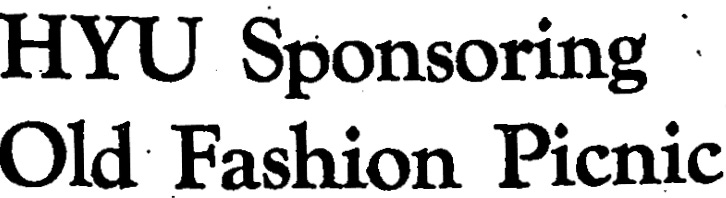
We would have read that Harlem Youth Unlimited would “sponsor a mammoth old fashioned picnic, festival and sports event in Central Park. This will be the first time in recent years that families are invited to come together for a day’s outing in Central Park and hundreds of people in central Harlem are expected to attend.”
“Another feature will be the use of the Laskey swimming pool. Sam Price, [who had come up with the idea to hold the picnic] along with his staff, is in contact with the Parks Department to have them waive the 25-cent fee from 10 a.m. to 4 p.m. so that as many as desire may have a chance to use the pool.
Harlem voters were solidly in support of Robert F. Kennedy during his campaign for the presidency. Following Kennedy’s assassination their support turned to Hubert H. Humphrey. In August, 1968, the “Harlem Citizens for Humphrey” organization moved into an office on 125th Street and held an opening event with free food and drinks.
“Sam Price, a key man in the Humphrey effort here, hosted the event several doors east of the Apollo Theater. Price is taking leave of his “public relations job at Haryou-Act’s Neighborhood Board #2 “to aid the Humphrey Drive for the White House.”
In 1970, during a time of campus unrest, I would have seen the June, 1970 Amsterdam News story that read:

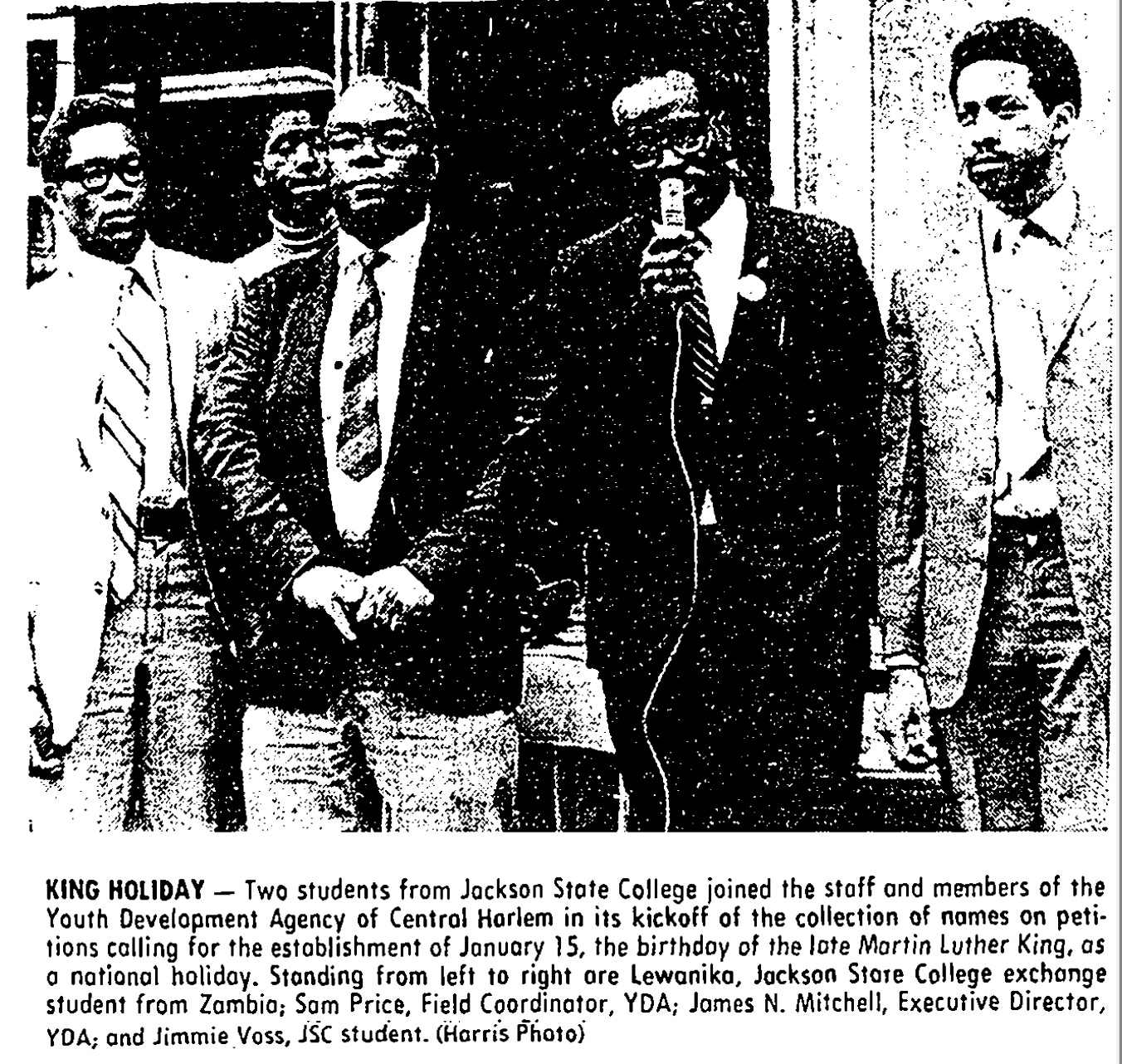
The story reported that two students from Jackson State College in Mississippi, were invited to Harlem in the aftermath of shootings by Mississippi State Police, who opened fire on a dormitory, killing two young people and wounding nine. Sammy Price, then Field Coordinator for the Youth Development Agency in Harlem, extended the invitation while also organizing a drug addiction awareness week culminating in a parade honoring the deaths of Harlem youth, and secondarily, organizing a ““drive to collect signatures in support of a bill declaring January 15, the birthday of the late Martin Luther King, a national holiday.” A photo accompanied the story:
I would have seen the December, 1970 story with the headline, “Board Election Set for Dec. 19,” to elect members for the boards of eight antipoverty agencies under Haryou-Act, and reported that Sam Price had been appointed Election Coordinator.
A 1971 story ran with the headline:
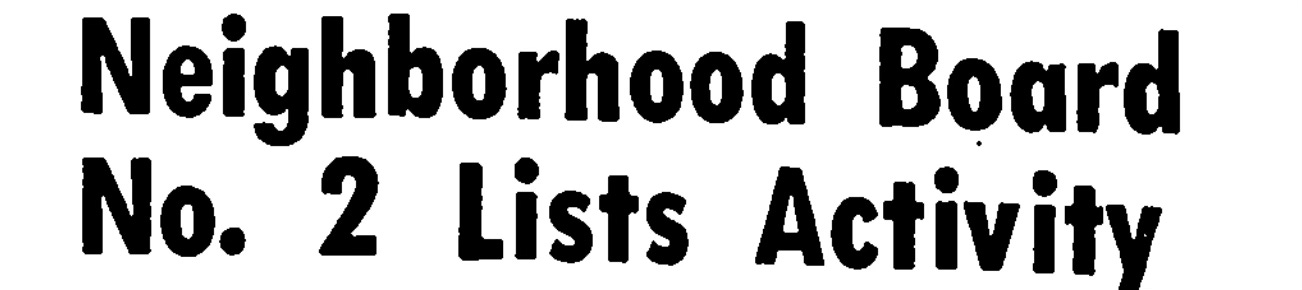
The opening paragraph read, “Sam Price, new director of Neighborhood Board No. 2, has announced that the Board is in a new thrust with its three components: Job Development, housing development, and adult education.” And: “Mr. Price also announced that a housing seminar will be held on Wednesday. There will be delegates from all the housing agencies in the Central Harlem area.”
If by chance, I happened pick up a copy of the New York Times in March, 1971, I might have seen a story by the Times jazz critic John S. Wilson, telling of Sammy Price’s return to performing music, with the headline:

“Sammy Price, who played piano at Barney Josephson’s famous Greenwich Village nightclub, Cafe Society, in the nineteen forties, has joined Mary Lou Williams, another graduate of Cafe Society, in providing music at Mr. Josephson’s current restaurant, the Cookery, University Place at Eighth Street.
“Miss Williams, who inaugurated the music policy at the Cookery last November, plays her piano there Monday through Saturday. But now there is music on Sunday nights, too, and Mr. Price provides it.
“Like Miss Williams, Mr. Price came out of several years of retirement to play there. When his close friend, Red Allen, the jazz trumpeter, died in 1966, Mr. Price took a job with the antipoverty program under Haryou-Act and is now director of Neighborhood Board No.2 in Central Harlem. Since then, he played only intermittently until Mr. Josephson persuaded him to spend his Sunday evenings at the Cookery.”
In 1974 I would have seen the Amsterdam News item with the story that confirmed once again Sammy Price’s long association with Adam Clayton Powell, Jr. Of course, I would have known that, having seen and especially heard, Sammy Price campaigning for Powell on the streets of Harlem.

“The Adam Clayton Powell, Jr., Senior Citizens Community Center of Neighborhood Board No.2, 2386 Seventh Avenue, was officially dedicated Monday during the annual awards affair of Board No. 2.”
“Sam Price is the director of Board No. 2 who sponsored the Center.”
I would have seen the stories, in 1976 and 1977, related to Sammy Price’s time as the musical director at Crawdaddy’s Restaurant, based in the Roosevelt Hotel.
On October 16, 1976: “Sammy Price, pianist, composer, singer and community worker, was honored on his birthday, October 8, at Crawdaddy’s, a supper club on Vanderbilt Street which features New Orleans type music and cuisine. Eubie Blake, the ageless composer and pianist, serenaded Price with his compositions. Sam Price, who commutes between New York and Europe like workers taking the subway downtown, also sang and played for his guests.
October 23, 1976: [Headline and caption accompanying a photo]: “Boogie King: Sammy Price, singer and composer was crowned King of Boogie-Woogie at his 68th birthday party at Crawdaddy, the New Orleans restaurant on Vanderbilt Street. Price, who is also celebrating his 53rd year of jazz playing, is shown cutting the huge cake.”
June 11, 1977: “Crawdaddy’s birthday party was a real New Orleans affair with Sammy Price and his Combo playing New Orleans Mardi Gras music, and pretty girls giving the guests root beer and Jambalaya. Traffic stopped on Vanderbilt Avenue.
On December 9, 1978 came the saddening headline, “Sam Price’s Wife Dies”:
“Sam Price, the globe-trotting jazz musician and Harlem community worker, will bury his wife, Nancy, Friday in Fairlawn Cemetery in Fairlawn, N.J., following rites at Levy & Delaney Chapel, 2257 Seventh Avenue.
“Mrs. Price, 64, a dressmaker, died in her apartment after four years of illness. Mrs. Price and Sammy were married 26 years ago in their native Texas and moved to New York shortly after. Besides her husband, she is survived by daughters, Mary, Barbara, Sharon, and Emma.”
Not long after the death of Mrs. Nancy Price, I would have read in Les Matthews’ “Mr. 1-2-5-Street” column:
“Musician Sammy Price will fly to Europe next week to launch a five-week tour.”
In May, 1979, under “Theater Briefs” came the notice:
Sammy Price, the jazz pianist, is back and he said things at the West End on 114th Street and Broadway will jump again.
In December, 1982, an item in the “Mr. 1-2-5 Street” column reported:
Sam Price, now appearing at the West End, will fly back to his regular gig at the Copley Plaza in Boston.
Finally, I would have seen this story, with a photo of Sammy Price, from a 1983 issue of the Amsterdam News, announcing that Mr. Price would hold a fundraiser at the West End Cafe for a college student arrested during spring break in Florida for allegedly assaulting two white girls.

Sammy Price, internationally known pianist who has performed with such jazz greats as Sidney Bechet and Henry Red Allen will perform a benefit concert to aid a “computer whiz-kid” Sunday, Nov. 6, at the West End Cafe, 113th St. and Broadway.
Sammy, also known as the “King of Boogie-Woogie,” is a longtime civil rights activist and community organizer. His performance at the West End Cafe is in support of the legal defense of Bronx College student, James Ellis. Ellis, a 21-year-old Physics and Computer Science major at Rensselaer-Polytechnic Institute in Troy, N.Y. is accused of assaulting two white girls in Del Ray Beach, Florida.
“Ellis,” according to Sammy, “has become a victim of the judicial system and he is facing charges for a crime in which the evidence clearly indicates he is innocent.
“I have known this kid since he was 14 years old,” Sammy continues, “and during this time I saw him become valedictorian of his junior and senior high schools and successfully compete for scholarships for some of the best schools in the country.
“Sammy asks all his friends to come out and support this effort, because ‘this kid is an asset to our community.’
“Showtimes are 2, 3, 4, and 5 p.m.”
Perhaps I would have gone to one of the shows at the West End Cafe in 1983, to help support the student Sammy Price had known for many years.
But of course, I was not born in 1908, as Sammy Price was–I was born in 1950 and knew very little about his activities in Harlem as I drove there in December, 1987, to begin studying with him.
Things can be infectious without being contagious. I must admit that I knew little about the history of the Blues and Boogie Woogie in America prior to Whynott's heartfelt memoir, "Setting a Tone, Lessons with Sammy Price." Sammy Price's music is infectious. Whynott's appreciation of Sammy's music is contagious.